
Saudi Arabia Builds the Track: TASARU Hub Partners With 5 Global Giants to Make Cars Local
TASARU Supplier Hub Partners with Five Global Tier-1 Suppliers to Localize Saudi Automotive Manufacturing
Saudi Arabia's automotive manufacturing ambitions have just shifted into high gear. In a major move announced at the 4th PIF Private Sector Forum 2026, the TASARU Supplier Hub has signed landmark agreements with five global Tier-1 automotive suppliers to localize the production of critical vehicle components within the Kingdom.
This strategic initiative, developed by Tasaru Mobility Investments—a company of the Public Investment Fund (PIF)—aims to build a comprehensive domestic supply chain, directly supporting the production ramp-up of Saudi electric vehicle brands like Ceer and Lucid Motors. The goal is crystal clear: to transform Saudi Arabia from a car importer into a regional automotive manufacturing and export powerhouse.

Why This Saudi Automotive Manufacturing News Matters
For years, the GCC's automotive landscape has been dominated by imports. While local assembly has existed, a full-fledged manufacturing ecosystem with advanced component production has been the missing piece. The TASARU Supplier Hub changes that equation fundamentally.
By bringing in established global players, Saudi Arabia is not just assembling kits; it's building the foundational industrial knowledge, technology transfer, and job creation required for long-term sustainability. This leapfrogs traditional development paths and aligns perfectly with the aggressive targets of Saudi Vision 2030.
Meet the Five Global Tier-1 Suppliers Coming to Saudi Arabia
The five partners represent a cross-section of essential automotive manufacturing expertise, covering everything from a car's skeleton to its seats. Here's who's setting up shop:
- Shin Young (South Korea): Will localize metal stamping for structural body-in-white production—essentially the car's core frame.
- JVIS (USA, via JVIS KSA): Will produce injection-moulded exterior plastic parts, including body panels and bumpers.
- Benteler (Germany): A chassis specialist, will manufacture critical components like subframes, axles, and hot-formed structural parts.
- Guangxi Fangxin (China): Will handle interior systems, producing instrument panels, centre consoles, and door panels.
- Lear Corporation (USA): The seating expert, will establish production for complete automotive seating systems and foam.
This collective move creates a nearly turnkey supply chain for an automaker, drastically reducing the need to import bulky, expensive components and cutting down production lead times.
Location: The Strategic Heart at King Salman Automotive Cluster
All this activity will be centralized at the MASARAT Mobility Park within the King Salman Automotive Cluster in King Abdullah Economic City (KAEC). This location is a masterstroke in logistics.
Companies benefit from a shared, plug-and-play infrastructure model that reduces initial setup costs and complexity. More importantly, the cluster's immediate proximity to the King Abdullah Port provides seamless access for importing raw materials and exporting finished vehicles and components to the wider GCC, MENA region, and beyond.
The GCC Impact: What This Means for Car Buyers
While today's announcement is about industry building, the downstream effects for consumers across Saudi Arabia and the GCC are significant. Here's what you can expect:
- More Competitive Pricing: Localizing production slashes logistics costs, import duties, and currency exchange risks. This cost efficiency can translate into more competitively priced vehicles from Saudi-made brands like Ceer when they hit the market.
- Faster Availability: With a local supply chain, production can be more responsive to regional demand. This could mean shorter waiting times for popular models and configurations.
- Job Creation & Economic Growth: This initiative is a major engine for creating high-skilled technical and engineering jobs for Saudi nationals, fostering broader economic development.
- A Stronger EV Focus: The partnership explicitly supports Saudi's EV ambitions, meaning more advanced, locally relevant electric vehicles designed for GCC conditions could arrive sooner.
Michael Mueller, CEO of Tasaru Mobility Investments, captured the ambition perfectly: “By attracting tier-1 global critical suppliers, the Kingdom is not just participating in the automotive race; it is building the track. These partnerships advance economic diversification and deliver long-term industrial resilience through strategic localisation.”
The Road Ahead for Saudi-Made Cars
This supplier hub is a critical enabler for Saudi Arabia's target of producing 500,000 vehicles annually by 2030. The immediate beneficiaries are the anchor OEMs, Ceer and Lucid, whose production scalability just became much more feasible.
For car enthusiasts and buyers in the UAE, Saudi Arabia, Kuwait, and across the GCC, the message is clear: the era of Gulf-made cars is accelerating rapidly. The next few years will likely see the first waves of these locally sourced vehicles, potentially offering a compelling blend of modern technology, regional suitability, and attractive pricing.
The TASARU Supplier Hub isn't just a business park; it's the foundation of Saudi Arabia's automotive future. And that future is being built right now.
Source: automotiveworld.com, saudigulfnews.com
Related Articles
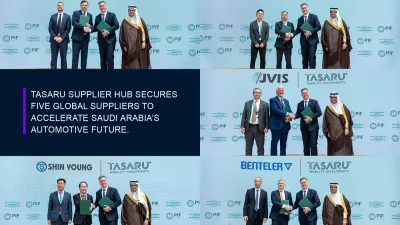
Breaking: TASARU Supplier Hub Signs 5 Global Tier-1 Suppliers for Saudi Auto Localization
TASARU Supplier Hub secures five global Tier-1 suppliers to localize critical automotive component manufacturing in Saudi Arabia, boosting Ceer and Lucid production.
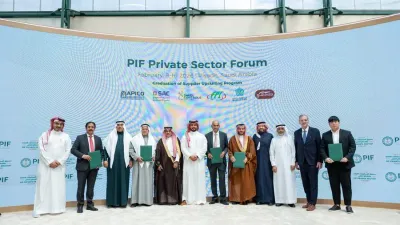
CEER Signs SAR 3.7B Deals for Saudi EV Localization Push
CEER inks 16 agreements worth over SAR 3.7 billion at PIF Forum, targeting 45% localization of EV components from Saudi companies by 2034.
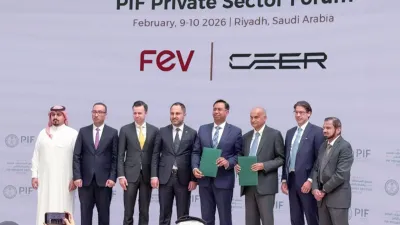
CEER Signs SAR 3.7B in Deals, Targets 45% Saudi Localization by 2034
Saudi Arabia's first EV brand CEER signs 16 MoUs worth over SAR 3.7 billion at PIF Private Sector Forum, targeting 45% localization by 2034 ahead of 2026 vehicle launches.