
GCC's $19B Autonomous Vehicle Future: Strategy& Report Reveals Huge Opportunity
The numbers are in — and they're staggering. According to a groundbreaking new report from global strategy consultancy Strategy&, the GCC is positioned to capture a massive $19 billion slice of the fully autonomous vehicle market by 2035. This isn't just a prediction; it's a roadmap for how the region could become a global leader in next-generation mobility.
Here's the headline figure: the global market for fully autonomous vehicles is projected to reach a colossal $182 billion by 2035. The GCC's estimated $19 billion share represents a significant portion of this future economy. The biggest segment? Robo-taxis, which alone are expected to create a $10 billion market within the GCC, accounting for roughly 18% of the global share for that service.

Why This GCC Autonomous Vehicle Report Matters Now
The timing of this report is critical. Across the UAE, Saudi Arabia, and other Gulf states, billion-dollar giga-projects are already laying the digital and physical groundwork for a driverless future. From dedicated autonomous lanes in NEOM to smart city initiatives in Dubai and Abu Dhabi, the infrastructure is being built today for the vehicles of tomorrow.
This isn't speculative fiction. It's a calculated projection based on current investments, regulatory momentum, and technological readiness. The GCC's unique combination of ambitious national visions, sovereign wealth, and greenfield development sites gives it a competitive edge no other region can easily match.
The $10 Billion Robo-Taxi Opportunity in the GCC
Let's break down that $19 billion opportunity. The standout is the robo-taxi segment. Strategy& projects this will be a $10 billion market in the GCC by 2035.
Why robo-taxis first? They're already proving themselves in controlled commercial pilots in markets like China and the US, where data shows they can be safer and more reliable than human-driven cabs. The consultancy suggests this service could be commercially viable in the GCC as early as 2028.
For residents, this means a future where hailing a completely driverless car through an app could become as normal as ordering a ride today. For investors and local economies, it represents a foundational new industry.
How NEOM and Smart Cities Are Building the Sandbox
The GCC isn't just waiting for the technology to arrive—it's building the perfect testing ground. Saudi Arabia's NEOM is perhaps the most ambitious example, designed from the ground up with autonomous mobility as a core utility. The UAE's myriad smart city initiatives are similarly embedding driverless technology into their urban fabric.
These projects serve as real-world sandboxes. They allow for the integration of dedicated autonomous lanes, centralized mobility hubs, and seamless digital infrastructure without the constraints of retrofitting old cities. This "blank slate" advantage is a massive accelerant.
The Three Tipping Points for GCC Adoption
The report outlines three critical phases the region must navigate to realize this $19 billion future:
Readiness for Pilot Projects: This initial phase involves controlled, limited-scale deployments in defined areas like NEOM or specific Dubai districts. The technology is proven, and the focus is on public familiarization.
Commercial Readiness: Here, autonomous services operate reliably in real-world conditions with full government backing and a clear regulatory framework. This is where robo-taxi fleets begin expanding across city networks.
Readiness to Scale: The final stage involves full integration into the daily transport ecosystem. Public acceptance is high, the business model is sustainable, and the services are ubiquitous.
The GCC has the potential to move through these stages faster than many established markets, thanks to coordinated top-down vision and investment.
What Experts from Strategy& Are Saying
The report's authors emphasize both the opportunity and the path forward. Andreas Gissler, a Partner at Strategy&, put it squarely: "Backed by ambitious visions and resources, the GCC is strongly positioned to seize a $19 billion opportunity and set a global benchmark for autonomous mobility."
He also highlighted the crucial next steps: "Achieving that goal will require coordinated regulation, infrastructure readiness, and above all, building public confidence in the technology — but the region has the means to deliver."
Mark Haddad, also a Partner at Strategy&, echoed this, noting the region's relative advantages in regulation and its ability to deploy capital strategically to build the necessary ecosystem.
Beyond Taxis: Buses, Trucks, and Passenger Drones
While robo-taxis grab the biggest headline, they're just one piece of the puzzle. The autonomous future includes much more. Europe is already testing autonomous shuttles, buses, and long-haul trucks, all of which have direct applications in the GCC's logistics corridors and public transit networks.
Another fascinating prospect for coastal cities like Dubai or Doha is the potential for autonomous passenger drones. These electric vertical take-off and landing (eVTOL) vehicles could revolutionize short-hop travel across waterways or congested urban centers, adding another layer to the mobility mix.
Why the GCC Can Outpace Europe and the US
Traditional automotive markets in Europe and North America face a huge hurdle: legacy infrastructure and complex, fragmented regulations. The GCC faces no such burden. New cities like NEOM can write their own rulebooks, creating flexible, technology-friendly regulations from day one.
This regulatory agility, combined with the deep financial resources of sovereign wealth funds aligned with Saudi Vision 2030 and the UAE's Vision 2071, creates a perfect storm for rapid adoption. The region isn't just adopting a technology; it's actively shaping its future around it.
Economic Impact for GCC Investors and Consumers
For stakeholders in the region, this is more than a transport story—it's an economic one. A $19 billion market will create new industries, attract global tech firms, and generate high-skilled jobs in software, engineering, data analysis, and fleet management.
For consumers, the promise is transformative: increased road safety, reduced traffic congestion, and potentially lower mobility costs. It also promises to increase accessibility for those unable to drive, fundamentally changing how people live and work.
What Happens Next for Autonomous Vehicles in the GCC?
The Strategy& report is a clarion call for coordinated action. The opportunity is quantified and the direction is clear. The next few years will be about moving from blueprint to reality.
Key milestones to watch include the first large-scale robo-taxi pilot in a GCC city, the publication of comprehensive federal or emirate-level regulations for autonomous vehicles, and major announcements from global AV manufacturers partnering with GCC entities.
The race is no longer about if autonomous vehicles will arrive in the GCC, but how quickly and seamlessly the region can capture this $19 billion future. The foundation is being poured today. The vehicles are coming tomorrow.
Related Articles
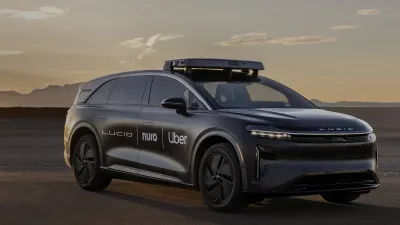
Saudi-Backed Lucid, Uber, Nuro to Launch 20,000+ Robotaxis in 2026
Lucid Motors, backed by Saudi Arabia's PIF, partners with Uber and Nuro to launch a global robotaxi fleet of 20,000+ autonomous Gravity SUVs, starting in 2026.
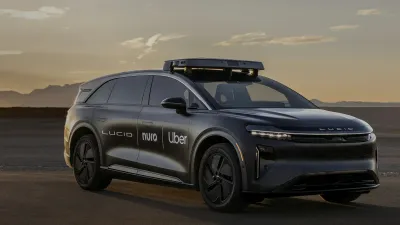
Just Launched: Lucid, Nuro & Uber Reveal Production Robotaxi at CES 2026 – Saudi Arabia Impact
Lucid, Nuro & Uber unveil production-ready robotaxi at CES 2026. Based on Lucid Gravity SUV, with major implications for Saudi Arabia and GCC markets.
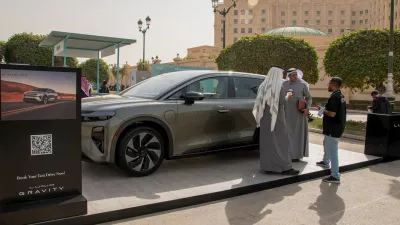
Lucid Starts Full EV Manufacturing in Saudi Arabia by End-2026
Lucid Motors confirms its KAEC plant will transition to full EV manufacturing by end-2026, ramping to 150,000 units/year by 2029 — a major milestone for Saudi Arabia's Vision 2030.