
Saudi Arabia Bans 29 Car Brands: What Buyers Need to Know
Saudi Arabia has just hit the brakes on 29 car brands. The Saudi Standards, Metrology and Quality Organization (SASO) and the Ministry of Commerce have imposed a temporary import ban on new light vehicles from manufacturers that failed to submit their 2026 supply plans under the kingdom's CAEF fuel-economy regulations.
The ban, which took effect in mid-June 2026, covers all new light vehicles up to 3.5 tonnes — passenger cars, SUVs, and light commercial vehicles alike. And it's not just obscure names on the list.

Which Car Brands Are Affected by the Saudi Import Ban?
The partial list of affected manufacturers includes some names that may surprise GCC buyers. Here are the brands caught in the ban:
- McLaren — the British supercar maker is on the list
- Volvo Cars — a mainstream premium brand widely sold in the kingdom
- Tata Motors — the Indian giant with growing GCC ambitions
- Maxus — the SAIC-owned commercial and EV brand
- Wuling — another SAIC brand with budget models in the region
- DFSK — the Chinese-South Korean joint venture
- Neta and Hozon New Energy — Chinese EV specialists
- LUXGEN MOTOR — Taiwan's automotive brand
- Foton — Chinese commercial vehicle manufacturer
- Borgward, Qoros, Lifan, Brilliance — Chinese brands with varying GCC presence
- ZHENGZHOU NISSAN, HAWTAL MOTOR GROUP, Greenkar Auto Tech, Chongqing Livan
- King Long, Golden Dragon, Higer — Chinese bus and commercial vehicle makers
But here's the thing. This is not a safety recall or a quality issue. It's purely administrative.
Why Did Saudi Arabia Impose the Ban?
The root cause is the Corporate Average Fuel Economy (CAEF) program, which requires every manufacturer selling vehicles in Saudi Arabia to submit an annual supply plan detailing projected volumes and expected fleet fuel-economy performance. The 2026 deadline came and went, and these 29 brands simply didn't file.
Think of it as the regulatory equivalent of forgetting to renew your registration. The kingdom isn't saying these cars are unsafe or inefficient — it's saying these manufacturers haven't done the paperwork required to keep importing.
Is the Ban Permanent?
No. This is a temporary measure. The ban lifts automatically once a manufacturer submits its compliant 2026 supply plan. The final deadline for submission is the end of 2026, meaning affected brands have a window to get their documents in order and resume imports.
That said, every day without a filed plan is a day those brands can't bring new vehicles into the Saudi market. For brands with thin dealer networks or limited Saudi inventory, the clock is ticking loudly.
What Does This Mean for Car Buyers in Saudi Arabia?
If you're currently shopping for a vehicle from one of the affected brands, here's what you need to know:
- Existing dealer stock is still available for sale. Cars already in the kingdom and cleared through customs can still be sold — the ban only stops new imports.
- Delivery delays are likely for custom orders. If you've ordered a specific configuration that hasn't arrived yet, check with your dealer on whether the vehicle cleared customs before the ban took effect.
- Warranty coverage should remain intact. The ban doesn't affect after-sales support or existing warranties, though parts availability could become an issue for brands with limited local stock.
- Resale value may take a short-term hit. Uncertainty around future supply can depress used-car prices for affected brands, which could actually make them bargains on the pre-owned market.
And the best part? If you're not shopping any of the 29 brands, nothing changes for you. Major sellers like Toyota, Hyundai, Nissan, Kia, and most premium German brands are unaffected.
How Does This Affect the Broader GCC Market?
Saudi Arabia is the GCC's largest car market by volume, so regulatory moves here ripple across the region. However, this ban is Saudi-specific — it doesn't automatically apply in the UAE, Kuwait, Bahrain, Oman, or Qatar.
That said, the CAEF program is part of a broader GCC push toward fuel-economy standards and emissions regulation. Other Gulf states are watching closely, and similar supply-plan requirements could follow. The 2026 Saudi action sends a clear message: the kingdom is serious about enforcing its fuel-economy framework, and no brand gets a pass.
For Chinese automakers in particular — who make up a significant portion of the affected list — this is a wake-up call. Rapid GCC expansion means nothing if regulatory compliance doesn't keep pace.
What Should Affected Brands Do Now?
The path forward is straightforward: file the supply plan. Brands that submit their 2026 CAEF documentation to SASO can resume imports immediately. The bigger question is why these 29 manufacturers missed the deadline in the first place — whether it was administrative oversight, strategic hesitation, or simply underestimating Saudi enforcement.
For brands like Volvo, which has substantial Saudi market presence, a swift filing seems inevitable. For smaller or newer entrants with limited Saudi operations, the ban adds friction to an already competitive market.
What's Next?
Expect rapid compliance filings from the bigger names on the list — particularly those with active Saudi dealer networks and customer orders in the pipeline. The real question is how quickly the smaller Chinese and niche brands respond, and whether any choose to exit the Saudi market rather than comply with CAEF requirements.
If you're a buyer eyeing a vehicle from an affected brand, our advice is simple: check dealer stock, confirm delivery timelines in writing, and make sure your warranty is backed by a local distributor — not an overseas entity. The 2026 Saudi import ban is temporary, but the disruption it causes could last months for some brands.
Related Articles

Li Auto Enters UAE & Saudi Arabia: L-Series EREVs Land in the GCC
Li Auto signs deals with Al Fahim Motors (UAE) and Naghi Motors (Saudi) to bring its L6, L7, L8, and L9 EREV SUVs to the GCC — marking the brand's first Middle East entry.
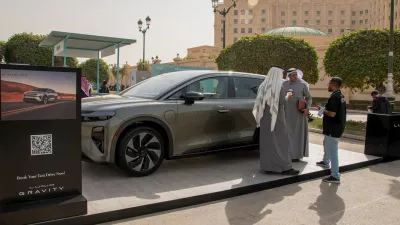
Lucid Starts Full EV Manufacturing in Saudi Arabia by End-2026
Lucid Motors confirms its KAEC plant will transition to full EV manufacturing by end-2026, ramping to 150,000 units/year by 2029 — a major milestone for Saudi Arabia's Vision 2030.

BYD Ti 7 Hybrid SUV Launches in Saudi Arabia Starting at SAR 147,900
Al-Futtaim BYD has launched the all-new BYD Ti 7 hybrid SUV in Saudi Arabia from SAR 147,900. With 735 km range, 5.3s 0-100 sprint, and AWD, it's BYD's 12th model in the Kingdom.