
Lucid Starts Full EV Manufacturing in Saudi Arabia by End-2026
Lucid Motors is going all-in on Saudi Arabia. The American-Saudi EV maker has confirmed that its AMP-2 plant in King Abdullah Economic City (KAEC), Jeddah, will transition from partial assembly to complete EV manufacturing by the end of 2026 — a landmark shift for the Kingdom's automotive ambitions.
Interim CEO Marc Winterhoff made the announcement, signaling that Lucid is no longer just assembling imported knock-down kits on Saudi soil. It will be building complete electric vehicles from the ground up, right in the heart of the GCC.

Why This Matters for Saudi Arabia and the GCC
This isn't a minor operational tweak. Moving from semi-knocked-down (SKD) assembly to full manufacturing means stamping, welding, painting, and final assembly all happening locally. That translates to real industrial capability — and real jobs — on Saudi soil.
The move directly supports Saudi Arabia's Vision 2030, which targets 30% of new car sales in the Kingdom to be electric by 2030. A homegrown EV factory pumping out up to 150,000 units per year by 2029 is exactly the kind of infrastructure that makes that target achievable, not aspirational.
And here's the bigger picture. The Public Investment Fund (PIF) — Saudi Arabia's sovereign wealth powerhouse — is Lucid's majority shareholder. This factory ramp-up isn't just a corporate strategy. It's a national one.
Lucid's 2025 Production Sets the Baseline
Before we get ahead of ourselves, let's look at where things stand. Lucid produced 18,378 vehicles in 2025. That's a solid number for a relatively young luxury EV brand, but it's a fraction of what the KAEC plant is being built to deliver.
The current KAEC facility has been handling partial assembly — essentially completing vehicles from imported sub-assemblies. The transition to full manufacturing is a quantum leap in complexity and investment, but it's the only path to meaningful volume.
Here's what the ramp-up timeline looks like:
- End of 2026: Full EV manufacturing begins at KAEC
- 2029 target: Production capacity reaches 150,000 units per year
- Hiring: Already underway to support the expanded operations
What Full Manufacturing Means in Practice
Full manufacturing is fundamentally different from assembly. Here's what changes at the KAEC plant:
- Body shop: Local stamping and welding of body panels and structural components
- Paint shop: Full paint operations rather than importing pre-painted bodies
- Drivetrain integration: Electric motors, battery packs, and power electronics assembled and installed on-site
- Quality control: End-to-end testing and validation under one roof
This also means local supply chain development. Lucid will need Tier 1 and Tier 2 suppliers setting up near KAEC, which creates a multiplier effect across Saudi Arabia's industrial sector.
The GCC Angle: Desert-Built EVs for Gulf Roads
There's a compelling narrative here that goes beyond economics. EVs built in the Saudi desert, tested in the Saudi desert, are inherently better prepared for the region's extreme conditions.
Summer temperatures in the GCC regularly exceed 50°C, and that's brutal on battery chemistry, thermal management systems, and cabin cooling. A locally manufactured Lucid benefits from real-world climate testing that no European or American factory can replicate.
For GCC buyers considering a Lucid Air or the upcoming Lucid Gravity, the Saudi-made badge carries weight. It means shorter delivery times, easier access to parts, and service teams who understand the product from the inside out.
And for the broader market, this plant could eventually supply vehicles across the Gulf — from the UAE to Kuwait, Bahrain to Oman — with shorter logistics chains than importing from Arizona.
How This Compares to Other GCC EV Manufacturing
Lucid isn't alone in betting on Saudi auto production. The PIF-Hyundai joint venture is targeting vehicle production in Q4 2026, and Saudi Arabia's own Ceer brand is preparing for its 2026 launch as the Kingdom's first homegrown EV marque.
But Lucid has a head start. Its KAEC facility is already operational, and the brand has a proven product on the road. The transition from assembly to full manufacturing is ambitious, but it builds on existing infrastructure rather than starting from zero.
What's Next for Lucid in the Region
The hiring expansion is already underway, with Lucid recruiting engineers, technicians, and production staff for the upgraded KAEC facility. Expect the pace to accelerate as the end-of-2026 full manufacturing deadline approaches.
For GCC consumers, the real impact will be felt gradually. Shorter wait times for new models, potentially more competitive pricing as import duties and logistics costs decrease, and a deeper service network across the region.
The 2026 Lucid Air and Lucid Gravity SUV will likely be among the first fully Saudi-built EVs to roll off the line. If the 150,000-unit annual capacity target holds, we could see Lucid become a serious volume player in the GCC by the end of the decade — not just a niche luxury import.
One thing is clear: Saudi Arabia's EV manufacturing story is no longer a future promise. It's happening now, and Lucid is leading the charge.
Related Articles
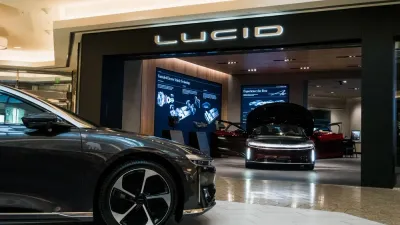
Saudi Arabia to Build EVs From Scratch by End of 2026
Saudi Arabia's Lucid Jeddah plant will shift from assembly to full EV manufacturing by late 2026, building up to 150,000 vehicles a year — here's what it means for GCC buyers.
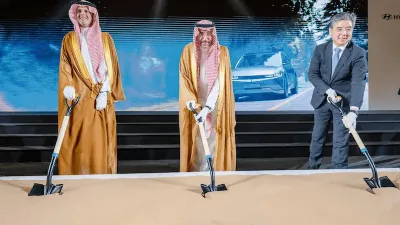
PIF-Hyundai Saudi Plant: 50,000 Vehicles From Q4 2026
PIF and Hyundai's joint venture will produce 50,000 vehicles annually in Saudi Arabia from Q4 2026, including ICE and EV models — a milestone for GCC auto manufacturing.

Lucid Plans Aggressive GCC Expansion: 1-2 New Markets Yearly
Lucid Motors will enter 1–2 new GCC countries every year, targeting Kuwait, Bahrain, Oman, and Qatar. Here's what the luxury EV maker's regional push means for Gulf drivers.